Episode 15: Food Delivery Apps
There is something about the ‘modernised’ (digitalised) ordering food experience that doesn’t sit right with me. Issues with digital service charges discussed before, I have a second issue with digital tipping: it’s nature seems to have created a highly unequal tipping environment.
Modern slavery is an issue cropping up repeatedly with food delivery apps (ubereats, deliveroo, justeat). I believe this is a result of it being one of the few workstreams available to migrant workers – often with tenuous right-to-work statuses. I have been a Deliveroo before, the pay is not great. I can’t imagine depending on it as my only income stream. Even worse, some of these migrant workers are exploited whereby they ‘rent’ the accounts they deliver on and only receive a small % of their hourly earnings – usually far below minimum wage.
Simply put, in my opinion, these are the people who deserve your tips. Not only is the job physically demanding, often in poor UK weather, they may need the cash far more. I’m not saying those who work restaurants/cafes with protected rights don’t deserve tips. They do. Ideally you tip both cash – but if you were going to tip one, and not the other, I think we should analyse our hypocrisy. You don’t order food from an ‘app’, you order food from other humans who cook it, package and deliver it. Rain or shine.
I can’t say I order food online much (maybe once or twice a year), but from my lived experience even a couple coins made a big difference to a delivery drop.
…
Wait a moment, what has this got to do with digitalisation?
Everything I say!
It’s part of the same process of digitalisation that atomises everything down to the individual experience. Throughout history, eating has been one of our core spaces for inter-personal interaction. From cooking, ordering, and the act of sharing the food itself, it has always been a highly social experience where bonds are forged and re-inforced, introductions made and problems discussed.
I think that in many cases, not all, digitalisation has been destructive to this social side of food. One negative outcome is solitude whereby dinner is alone in-front of YouTube. Not even paying attention to the food you are eating. I’ve been there. I don’t think this is good for us.
I think the tipping thing is more of a reflection of this negative undercurrent of change. I think the idea of tipping as mandatory in restaurants (good thing?) and tipping as optional for app-based delivery is a symptom of two different histories: the former as heritage of the long tradition of eating with others, whereby you interact with other humans, and thus feel obliged to help them financially for good service. The latter a new-age myth that we can elevate beyond humans into the digital – by conveniently ignoring the cooks, cleaners and drivers that bring us food due to the manicured app interface.
A perfect example of this new age myth is The Salad Project ‘lockers’ in the financial district (City/Bank) in London. You order your salad on the app. The minimum wage workers are hidden behind a screen so you don’t have to look at them. Your corporate slop bowl magically appears in a delivery box that you can identify with your phone. You can suspend the belief your salad appeared in the pick up point human free. As if by magic.
Except it didn’t, obviously.
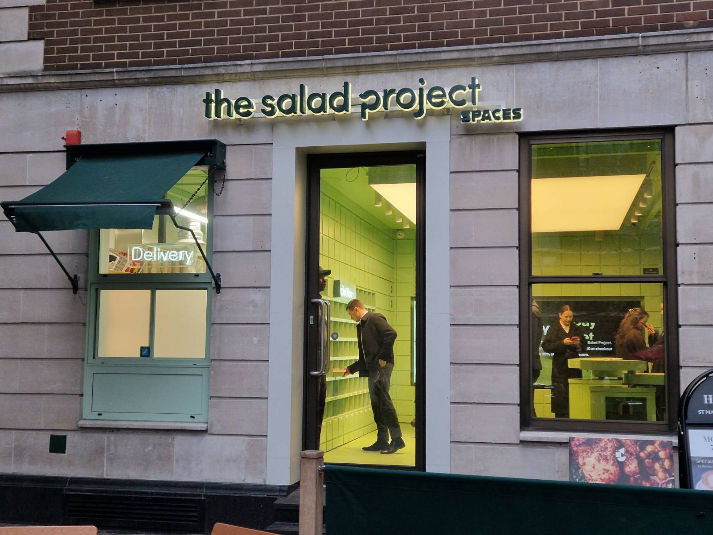
The Salad Project, around Bank. 15/02/2025. Own photo.
…
My personal take on ordering food?
Not for me (most of the time).
I stopped ordering deliveroo/ubereats because I thought the experience sucked. Higher prices, cold food, service charges, platform charges, delivery charges.
And for what?
If I want take-out, I can just walk to the take-out. If I want to get it delivered, 9 times out of 10 you can just call them up and get it delivered. Cheaper and more margin to the restaurant anyway. But I admit, there is a certain use case that for me too where it is convenient.
My issue is really with the experience in general. But I started this blog on the tipping thing because I think there’s a hypocrisy in how we approach tipping, one that reflects a change towards isolated, elevated, digital individuals, who do not owe their fellow humans anything. And I don’t like it. Because we owe each other a better future.