Episode 12: Digitalisation of Dating
It’s somewhat easy once you are in a committed relationship to forget how terrible dating has become for many people. I put part of the blame for this on digital culture. Today is a short rant hopefully with some solutions.
Problem 1: Dating apps are rubbish
Dating apps are designed to make money, not spread love in society. The result is a toxic atmosphere for the two main target groups. Women have a toxic experience of filtering through a sea of abuse, unsolicited advances and objectification. Men have a toxic experience of well, silence.
Their profit model requires loneliness and desperation for validation. Their user-base in almost all cases is majority male, and the commodity they are selling to men is single women (I have never met a women who has paid for Tinder Gold, which would make sense?). My experience, many years ago, was not atypical. I had various dating apps between ages 19 and 24. Across those five years I had possibly 50-100 matches, 20-or-so conversations and one actual date. To my women readers, this may be surprising. I suspect to my male readers, it is not.
You can imagine how soul-crushing that was for my self-esteem at a young age. Dating apps made me feel ugly, unwanted and fuelled feelings of inadequacy. Fortunately, for just £9.99 a month I was able to make those feelings go away…
…I’m joking of course. I fortunately learned quick just how manipulative these tech platforms are and have met my romantic connections through the years (and my girlfriend!) in real life. However, this leads to the second problem:
Problem 2: demolition of third spaces and organic matchmaking
There’s a perception, likely fuelled by online media, that apps are the only way to make connections. Fortunately, this digital concept is not reality. The latest from YouGov polling still has the pub beating Hinge. Long live the pub.
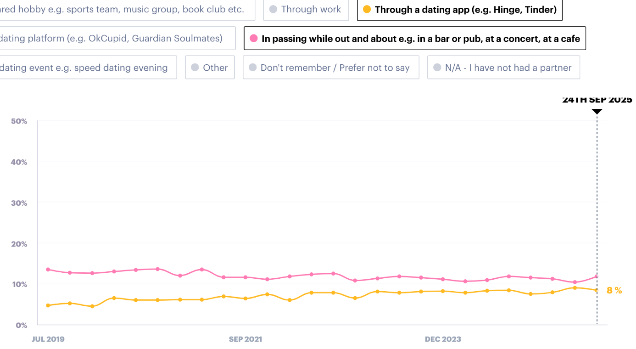
With that said, there is some truth to this narrative. Due to wider cultural and economic changes, it is true that is harder and harder to meet new people. Hela, this is not a political blog as aforementioned. My advice in this area would be a short list of places I’ve met dates or partners. Sports, clubs (not nightclubs), pub, friends-of-friends, volunteering, work. The point being is that third places do exist, you just gotta get out there.
If you are sat there swiping on dating apps, feeling mouldy as they chip away at your self-esteem and you feel yourself becoming an object. There is hope. Delete the apps. They either want your money or to sell you as an object. Join a sports club, join a non-sports club, start volunteering, go to community events. It worked for me. It’s worked for thousands of years and will work for another thousand. Hopefully. Unless the tech bros get their way.
Problem 3: digitalisation has warped expectations
This isn’t a long comment and is particularly straight-forward. Social media has placed these insane expectations of love on younger people. According to Instagram, women are to be simultaneously sexy and trad-wife, educated but also docile, puppy-eyed but also powerful. And without opinions, obviously.
Men are to be tall (6′ being taller than 87% of the male population in the UK), ripped, rich (but also not sleep deprived from work), well-dressed, both emotional and emotionless (possibly my favourite dichotomy) and empathy is a weakness that must not expressed (another odd element).
And that’s just the pre-requisites for dating, never-mind the expectations being invented for existing partners…
What a bunch of brain-rot. Best anti-dote being to get off social media and not engage with these ideas. Life isn’t a movie or a highlight reel. It’s real life.
Problem 4: texting causes arguments
My third issue with digitalisation is I firmly believe that texting causes a lot of arguments. And I am guilty!
Yes, some arguments, you were going to have anyway. But a lot of them? I genuinely think a lot of arguments stem from how useless of a communication medium texting is.
Texting is new. Let’s not forget that. The idea of instant messaging is only about 15-25 years old. Before that we had letters, phone-calls and e-mails if you were modern. All of which require a bit of thought, a bit of consideration and more effort into expressing your tone.
Texting is shooting your emotions straight from the hip, guessing someone else’s tone, anxious-attachment in the form of near-constant touching base. I don’t think these things are great for relationships. Especially if the subject is sensitive.
We can avoid a lot of relationship conflicts by picking up the phone. Or sending a letter. Or waiting until you are in-person. It’s very easy to fly off the handle behind a keyboard. It’s harder to spout our own rubbish when you have to look someone in the eye. This doesn’t mean texting needs abandoned, but perhaps a ground rule for keeping all conflicts, disagreements, negative feelings and debates away from text is a good idea?
I’m still guilty of having sent the ‘you never texted me back’ text. Ironic I know. I can do better.