Episode 13: Digitalisation of Ero and the harm of digital pornography
If you are my family/friend, please tread carefully reading this one! Particularly Part 2 which is my own journey.
I will state foremost that I do not take a puritan or moral opinion on this subject of judgement. I want to point out the harms without judgement, nor moralising. Likewise for wider commentary, I consider myself a feminist and this isn’t some rant against women’s sexuality.
Pornography accounts for over 1/3rd (!!!) of internet traffic, so it is a disservice to not discuss it. It is this incredibly widespread thing, we don’t talk about, which is causing lots of problems. Kinda like how cows are driving the climate crisis, not aviation, but I digress…
Part 1: Problems for Society
Before we get into digital eroticism, its quite necessary to start with the current social context.
There is a widening ideological gap between young men and young women. This is a new thing, and considerably alarming. The graph below from the Financial Times shows this widening gap and its proliferation post-2015. Although there are many variables, it’s worth noting this is around the same time social media started having such an intrusive role in people’s lives.
Alongside, social media, I think that the digitalisation of eroticism is a key reason for this ideological divide. It is both a symptom and a cause. The wedge of difference between men and women has been driven wide open for the purposes of making money by individuals and companies active in social media, pornography and general adult content. Because extremes make money.
Considering the majority of these young people will be cis-gender and straight-leaning, how they perceive each other in the digital space is undeniably important for the purpose of courtship and healthy romantic-sexual relationships (obviously issues extend beyond this basic groups, but I have to keep this blog short).
So how do men and women perceive each other (sexually)?
I don’t have much experience to speak to how women perceive men, but some thoughts on how I see women being perceived. To be clear, I do not condone/hold these views myself and highlight them to oppose them.
- Social media targeting men plays on classical male fears built from decades of entrenched patriarchy (impotence, disposability, inadequacy and poverty).
- In these fears women are the reward (as objects) to be won or conquered by men by way of being potent, strong, indisposable, adequate and rich.
- Often in male-centred social media, women are portrayed as extreme ends of the ‘madonna-whore complex’.
- They are either pornified, with exaggerated sexual features and sexualised in random contexts.
- Or ‘tradwives’, covered up in submissive domestic roles.
- This obviously is not a true-reflection of reality, and these ideas underpin a lot of problematic gender relations upheld by both men and women.
- Pornography users admit that their consumption has become more extreme through time, admitting a numbing effect. Women in these contexts are objects to abuse, hurt and use so that men are potent, indisposable, adequate/powerful/rich.
- The pornified digital space of social media is an on-ramp to more hardcore pornography.
- More recently the lines between creator and porn-star have become increasingly blurred (is Bonnie Blue a porn-star or a social media star? and why is it that men can’t stop talking about her – do they love to hate her, or do they hate that they love her?)
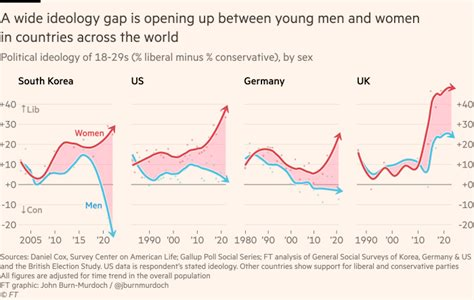
Source: Financial Times
The question you are probably asking is, is this a new problem of digitalisation, or just an issue of pornography in general that’s always been there?
Admittedly, the answer is not clear cut. Of course there’s an abundance of progressive erotic content, and there’s also an element of empowerment and ownership of particularly female sexuality. Likewise similar debates have raged for decades about whether porn helps or hinders gender relations. I cannot answer everything. That said, I think that specifically some aspects of erotic content becoming digital has facilitated an evolution and direction way-laden with harm.
Part 1: eroticism has become digital
Porn is no longer sold in dirty magazines at WHSmith (can’t say this is a massive loss), seedy VHS stores and even seedier theatre screenings (unbelievably, this used to be a thing). Today, it is instantly accessible to everyone with a smartphone. So everyone then. Whenever, wherever.
It’s not just the hub on your boyfriend’s smartphone. It’s AI slop e-books (trained on decades of WattPad). It’s Dipsea. It’s bloody well TikTok at this point.
It’s everywhere because porn, at least on the surface, has become decentralised thanks to digitalisation. Production companies have wained in importance with the proliferation of personalised pornography. Individual OnlyFans creators tailor to every single possible desire. Major sites and forums have categorised, filed and ranked content according to every possible niche. And now there is even AI porn. Every single possible kink/interest/desire or whim can be met in an instant down to the exacting detail. This includes the horrific proliferation of deepfakes, allowing men to turn real women that they know into their personal porn-stars. This is not good.
Porn is increasing in volume and accessibility way beyond what was historically considered ‘in moderation’, damaging the individual (more in Part 2). This is damaging for our society. The content itself has gravitated towards perfection, creating impossible standards (across all realms: body, sexuality, interests and candour) and expectations within romantic relations. Again not good.
But what can we do?
Given erotic content’s widespread consumption across nations, religions and genders, I think its fair to say that it is going to stay. It’s an integral human interest and desire. A ‘ban it all’ approach seems like a reactionary approach by men intimidated by women’s sexuality. Not to mention, it doesn’t work anyway, with even the most religious and conservative countries having porn (and unsurprisingly, some of the highest consumption).
I can’t offer all the solutions. But some thoughts: consider banning AI pornography specifically. There’s pretty much zero benefit for society (excluding niche circumstances), and a lot of costs. It’s worth noting in defence of individual creators AI porn, like most AI content, is trained on stolen material. Next, I’ll be honest, I support the Labour govt’s intervention to try restrict access for minors, even if it was implemented poorly. The volume of sexist and violent pornography now being consumed by teenage boys alarms me. Finally, we need some more open and frank cultural conversations about what a healthy approach to erotic content for adults look like. And what that content maybe shouldn’t contain.
Sort of like the polarisation of ideology, we seem to have voluntarily backed ourselves into a corner with no nuance or compromise, where you are either for or against pornography. Middle-grounds do exist.
Part 2: pornography ruined my capacity to have fun
Away from societal costs and getting more personal, I want to share a similar story as described in Season 1. With books, music, movies and most entertainment. The issue I found with digital pornography as an individual is its sheer abundance.
It’s like an instant dopamine button with no safety controls. Digitalisation has made the treasure chest as good as endless. Before you might finish viewing a magazine, a smutty book, a purchased video or whatever. Now there’s no end.
And there’s no societal conversation about what ‘moderation’ really means. Online articles aren’t really much help. Not because most of them are just AI slop, but because they give you the vague idea that addiction is only addiction when it starts to interfere with the rest of your life.
They mention nothing of the slow frying of your neurons, that barely percievable slow-burn of your capacity to have fun. The gradual, very gradual, down-ticking of your baseline happiness. The slow increase in your snappiness, grouchiness, and moodiness. Its so slow you might not even notice, you might think, “I’m just getting older”.
“But hey? I only consume X(XX) a few times a week. It doesn’t affect my personal life. I have a happy relationship. I’ve got a good job, and friends, and I exercise, and I eat well. I’m doing fine right?” – me, ages 21-27, probably.
Wrong.
It was such a slow effect it took me years to realise pornography’s influence on my reward system. Months into My Analog Life, I have found myself considerably happier, out-going and excited for life. So much so my family have friends have literally asked me, ‘are you alright?’
I cannot separate out the effects of each intervention, but I’d wager it’s been 50% my new approach to pornography, and 50% the cumulative effect of eliminating/controlling other cheap sources of dopamine such as social media. Your neurons need to reset, you need to be bored sometimes, to be happy other times.
So what is this new approach?
As above, kinda like social media, I decided a new approach was needed. The current path was hurting me, but I had failed the cold-turkey approach before. A lot of the idea’s surrounding the ‘cold turkey’ approach were problematic. You quit cold-turkey, you relapse, you self-flagellate as punishment and promise to do better, you relapse.. and you go round and round. Cycling between shame and glory (sounding like the madonna-whore complex anyone?).
But your sexuality isn’t a fight between good and bad, between holy and evil, between right and wrong. It’s part of being a mature grown animal.
Obviously this is context dependent. If you are having regular sex with a partner, then you can probably go for cold turkey. But in my circumstance I’ve been in a long-distance relationship for most of 2025 and harassing my poor girlfriend all-the-time is hardly a solution (side-note: talk to your partner, all the discussed considerations were with communication and support from my partner).
So my solution has rested on a few key concepts:
- significantly reduce frequency of consuming any new pornographic material (and thus dopamine spiking). Wean/wind down through time.
- only consume art/drawn material.
- pay for anything you consume.
To achieve this I’ve aggressively used LeechBlock and MacOS system settings to slowly but surely prohibit and cut-off trodden paths. If you have been a pornography user for many years, perhaps since you were a teen, you’ll find your habits/neural pathways are very well established. So breaking from the mould is likely to be replete with stumbles, step-backs and frustration. But its important to not get stuck in a shame loop.
In the absence of truly ‘analog’ options, I then subscribed to a couple artists I like on Patreon who release content on a monthly basis (via email), reducing frequency of new content from 3-4 times a week to 2-3 times a month.
This has been working for me. Everyone is different but I think the concepts are more important than any specific implementation. Specifically no.3. Our wallets have always been a natural balance/check on our habits, until we became the products.
Comments are welcome. Naturally it was quite scary being vulnerable in this capacity but I hope some of the above helps someone reading. Thanks for reading.